
Customer analytics may sound familiar, but the surrounding expectations have changed dramatically. Today, customers demand personalized experiences, real-time reactions and services that evolve with their needs. Voice of the customer (VoC), enhanced by GenAI, makes this possible — not once per quarter, but every single day.
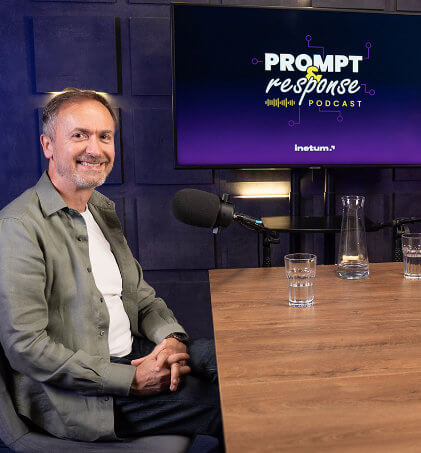
🎥 Watch the full episode below, then explore the cleaned and structured transcript.
Prompt & Response Webcast #3 – Transcript & Key Insights
- 1. Why customer analytics is more important today than ever
- 2. What traditional analytics misses
- 3. Real business outcomes: retention, acquisition, experience and cost
- 4. Use cases from the field
- 5. What counts as “Voice of the Customer”?
- 6. How GenAI transforms VoC and customer analytics
- 7. Implementation: where organizations really struggle
- 8. How to start (and avoid getting stuck in POC mode)
Why customer analytics is more important today than ever
Even if the concept feels old, the context is new. Customers share huge amounts of data with banks, telcos, retailers, streaming platforms – so they naturally expect companies to use it. The frustration of being asked for income details by a bank that already sees your monthly transactions is a perfect example of this gap.
Modern expectations are shaped by:
- constant exposure to personalized digital services,
- dynamic customer behaviour,
- and a market where switching providers takes seconds.
That’s why treating customers the same way they were treated three years ago simply doesn’t make sense any more.
What traditional analytics misses
The classic model focuses on CRM, demographics and historical events. Useful – but not enough. It answers what happened, not why.
Voice of the customer fills this gap by analysing unstructured, emotionally rich feedback coming from:
- social media,
- forums,
- call centre transcripts,
- and even audio signals like tone or sentiment.
This enables companies to understand not only behaviour, but motivation.
“Voice of the customer helps you distil emotions and understand the reasoning behind customer actions – something traditional analytics doesn’t provide.”
This blend of quantitative and qualitative signals becomes especially powerful when used continuously, not as a quarterly exercise.
Real business outcomes: retention, acquisition, experience and cost
Modern customer analytics delivers value across the entire lifecycle:
Retention
Predict who is likely to churn — and act early.
Acquisition
Target the customers most likely to buy, instead of “everyone.”
Experience
Move toward the long-discussed segment of one. Younger generations expect personalized communication, offers and support.
Operational efficiency
Communicating to the wrong customers is costly — not because an email is expensive, but because irrelevant outreach damages loyalty.
Meanwhile, VoC adds something unique: real-time feedback about product perception, service quality and process friction, making it the “cheapest operational audit” a company can have.
Read also: Use data to make informed decisions. Understanding the Importance of Data-Driven Decision Making
Use cases from the field
Pharma: designing what customers actually need
A large pharma company digitized a previously analogue reimbursement process. By analysing comments from patients and healthcare professionals on social platforms, two additional modules emerged as essential:
- direct communication between patient and HCP,
- personalized education on the disease.
These insights weren’t identified internally – they came directly from unstructured market feedback. Including them made the solution more valuable and easier to implement with stakeholders like the Ministry of Health.
Read also: Big Data in healthcare: management, analysis and future prospects for healthcare organizations
Banking: from churn and propensity to behavioural insights
Banks actively use predictions such as churn risk, propensity-to-buy or segmentation models. But the real change comes from combining them with behavioural signals: app usage, transaction patterns, and voice-of-customer input.
Machine Learning finds customer segments automatically, but explaining them used to be difficult. GenAI now helps describe segment behaviour in plain language – making analytics accessible to business teams.
Consult your project directly with a specialist
Book a meetingWhat counts as “Voice of the Customer”?
Practically, it’s the continuous analysis of unstructured data at scale, refreshed daily or even hourly.
Sources include:
- comments, reviews, posts,
- call centre transcripts,
- audio-based sentiment,
- any form of “free speech” not influenced by structured surveys or questionnaires.
What matters most is actionability. Reports without operational follow-up add no value. In a mature setup, organizations use real-time dashboards to guide decisions the same day – not weeks later.
How GenAI transforms VoC and customer analytics
- Summaries at scale
10,000 comments? GenAI condenses them during your morning coffee.
- Explaining ML-driven segments
Machine Learning segments are powerful, but often challenging to interpret.
GenAI generates human-readable descriptions that product and marketing teams can use immediately.
- Personalized communication
With customer attributes in place, GenAI can tailor emails, notifications, offers or scripts – enabling “segment of one” communication in practice.
- Accessibility for non-technical teams
Sales, CX and marketing teams can finally use advanced analytics without writing code.
This shift accelerates adoption and encourages experimentation.
Low-/no-code tools support this trend, allowing small teams to build prototypes quickly – though enterprise deployment still requires proper governance.
Implementation: where organizations really struggle
The greatest obstacle is rarely the model itself – but the operational process around it.
One bank had excellent analytics, yet results were ineffective. Why?
Analysts exported fresh data to Excel, reworked it for days, prepared presentations, waited for meetings… By the time campaigns launched, customer behaviour had already changed.
The lesson is clear: real-time analytics is useless if wrapped in a slow decision cycle.
Other challenges include:
- unclear ownership of the data and process,
- scattered responsibilities,
- insufficient platform readiness,
- PoCs that never evolve into production.
VoC and advanced analytics require both business and technology ownership – not one or the other.
How to start (and avoid getting stuck in POC mode)
Start small
Choose one product, one market or one business line. Prove value quickly, capture results and use them internally to gain traction.
Design for scale from day one
Even a small PoC should:
- have a clear owner,
- include reporting for decision-makers,
- align with a future architecture that supports 10× more traffic.
Build end-to-end
A PoC isn’t just a model. It should include:
- data ingestion,
- analytics,
- insights,
- dashboards,
- decision outputs.
Only then can leadership understand its value and support further investment.
Why a partner can accelerate results
Customer analytics, VoC and GenAI require a combination of strategy, business understanding, data engineering, modelling and governance.
Not every organization can build all these competencies internally — at least not quickly.
Sometimes the right move is to apply experience gathered from dozens of similar projects, avoid common pitfalls, and accelerate adoption with a partner.
As competition intensifies and fintech-like experiences set new standards, companies that fail to modernize customer analytics risk falling behind.
Ready to take the next step?
Your AI journey starts with a conversation. Share your challenge, idea, or question, and our experts will respond with insights and practical guidance. Talk to us- 1. Why customer analytics is more important today than ever
- 2. What traditional analytics misses
- 3. Real business outcomes: retention, acquisition, experience and cost
- 4. Use cases from the field
- 5. What counts as “Voice of the Customer”?
- 6. How GenAI transforms VoC and customer analytics
- 7. Implementation: where organizations really struggle
- 8. How to start (and avoid getting stuck in POC mode)