Everyone still says IoT is the future. In 2026 that sentence is already outdated. Connected devices are not a promise, they are infrastructure: inside factories, supply chains, buildings, energy grids and hospitals. The real question is no longer whether your assets are connected. It is whether your organisation can turn their data into decisions, uptime and revenue.
🎥 Watch the full episode below
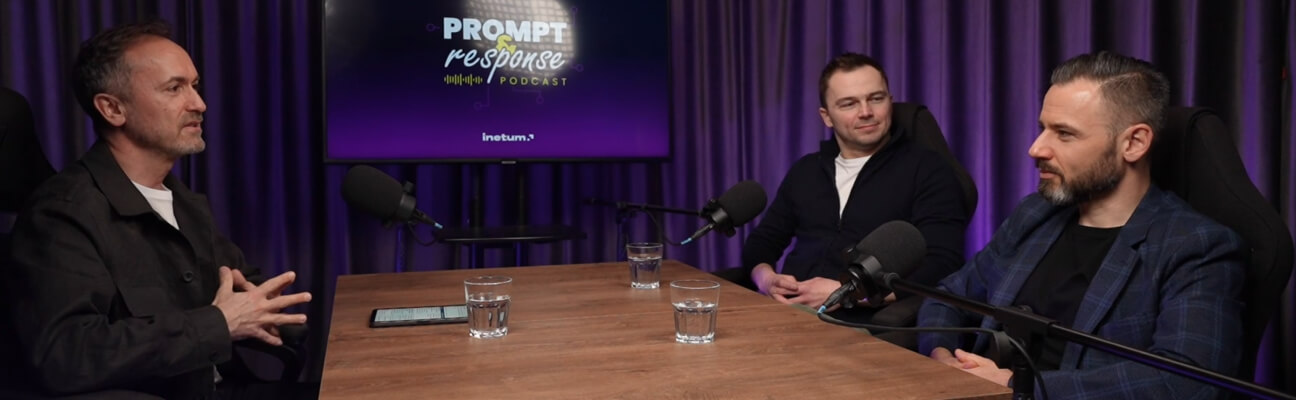
In the fifth episode of Prompt & Response, the Inetum podcast about AI in practice, host Piotr Mechliński (Data & GenAI Manager EEMEA, Inetum Polska) talks with Przemysław Saniak (Business Development Director) and Andrzej Gumieniak (IoT Practice Leader) about what changed, what still blocks scale, and where AIoT, Artificial Intelligence of Things, is heading next.
TL;DR. IoT is no longer the buzzword, it is the quiet hero running under the floor of modern enterprises. AI is the brain that finally makes that nervous system pay back, as our expert sums up. The winners in 2026 are the ones who combine edge AI, a Unified Namespace for their device data, and serious data governance, and who start from a business case instead of a shopping list of platforms.
Key takeaways from the episode
- IoT is mature: over 20 billion devices were connected by the end of 2025, a number expected to double by 2030.
- Predictive maintenance can cut unplanned stops by up to 70%. Smart buildings can save 20 to 30% on energy and water (U.S. Department of Energy).
- The next step is AIoT: intelligence moves to the edge, the nervous system gets a brain.
- The closed loop is the real shift: not only reading data, but sending decisions back to devices in real time.
- The biggest blockers are legal (Cyber Resilience Act, NIS2), organisational (who owns IoT inside the company) and technical (20 to 30 year old PLCs, vendor lock-in).
- Unified Namespace is becoming the default architecture to unify device data and feed AI agents with context.
- Data governance is not optional anymore. Without a catalogued context, LLMs and agents cannot act reliably on operational data.
- 1. From IoT to AIoT: why the name changed
- 2. Where AIoT actually creates value
- 3. Edge AI and custom models: why manufacturing is different
- 4. The integration challenges nobody warns you about
- 5. Unified Namespace: the foundation for agentic IoT
- 6. Data governance is the new battleground
- 7. What comes next: agentic IoT and Industry 5.0
- 8. Where to start if you are beginning today
- 9. FAQ
From IoT to AIoT: why the name changed
The term AIoT, Artificial Intelligence of Things, is not marketing polish. It captures a real shift: intelligence no longer lives only in the cloud.
Three forces push in the same direction:
- Smaller devices, bigger compute. Miniaturisation lets companies deploy far more sensors and actuators without expanding footprint.
- Edge inference. Predictive models are now small and efficient enough to run directly on the device. Less round-tripping to the cloud, faster action, lower cost per decision.
- Enterprise context for AI. Real-time sensor streams combine with vector databases, retrieval augmented systems and company documentation so that AI agents can reason over operations, not just transactions.
If IoT is the nervous system of the enterprise, AI is the brain. You just combine them to get value out of the whole body.
Andrzej Gumieniak, IoT Practice Leader, Inetum Polska
Where AIoT actually creates value
There is no shortage of sensors. There is a shortage of good answers to one question: what changes in cost, uptime, revenue or speed because of this deployment?
Przemysław groups the real payback into three streams.
Cost optimisation
- Predictive maintenance. Reduction of unplanned stops by up to 70%, with the matching cut in downtime cost.
- Smart buildings. According to the U.S. Department of Energy, smart buildings can save up to 30% on energy and 20 to 30% on water consumption.
- Smart cities. Harder to quantify, but quality of living and operational efficiency improve.
New business models
Connected products make “as a service” models practical: equipment as a service, usage based contracts, proactive SLA management. The trade-off is real: vendors take on more operational responsibility, but they gain deeper, longer customer relationships.
The closed loop
Andrzej adds the stream that separates mature players from beginners. The data flow is no longer one way, bottom-up. Once you trust the models, you let the system send commands back to the devices and steer production in near real time. That is the step where IoT stops being a dashboard and starts being an operating system.
The value is not in knowing faster. It is in reacting faster, and that is where AI earns its keep.
Przemysław Saniak, Business Development Director, Inetum Polska
Edge AI and custom models: why manufacturing is different
Manufacturing rarely fits a generic AI template. Every plant is different, every process has its quirks, every shop floor has its own mix of old and new equipment. That is why AIoT in factories leans toward custom models and edge AI.
Two practical consequences:
- Not all data is gold. Edge devices filter and summarise at the source, so only relevant signals reach the central systems.
- End-to-end streams. Decisions happen where they belong: at the edge for safety and latency, at the core for cross-plant optimisation and learning.
The integration challenges nobody warns you about
Scaling AIoT is worth it, but the path is rarely clean. Inetum IoT experts name three categories of friction.
Legal and regulatory
The EU keeps raising the bar: Cyber Resilience Act, NIS2, sectoral rules on top. If connected devices touch critical infrastructure, compliance is not a backlog item, it is a design constraint.
Organisational
IoT often lands between departments. Is it IT? Is it production engineering? Who is the product owner? Scaling without a clear owner guarantees pilot limbo. A defined operating model is as important as any platform choice.
Technical and legacy
Factories run on equipment that is 20 or even 30 years old. Old PLCs are already wired into SCADA systems, so connectivity exists, but it is brittle and locked to specific vendors. Inetum has seen sites where assets were linked only by SMS, because that was the only usable channel. That is enough to start, but it is not an architecture.
Work with Inetum
Turning AIoT from slide deck to production
If you are building your AIoT roadmap, scaling edge AI on a real shop floor, or wiring a Unified Namespace into a legacy estate, Inetum can help. We combine 27,000+ professionals in 19 countries, deep manufacturing and energy expertise, and an AI practice with 17,000+ AI-literate specialists and 1,200+ certifications.
Tell us where you are and what you want to prove first. We will come back with a short, honest read on what is feasible, what it will cost, and how to measure it.
Unified Namespace: the foundation for agentic IoT
The emerging answer on the shop floor is the Unified Namespace (UNS): a single, standardised place where every device publishes its state in real time, in a format everyone in the organisation can understand.
Two ideas underpin it:
Pub-sub over polling
Instead of legacy systems constantly querying PLC registers, devices publish events to a central message bus. Any consumer, SCADA, MES, analytics, AI agents, picks up what it needs.
Shared naming and semantics
Every signal is named and described consistently, so meaning does not get lost as data propagates.
UNS is not only a networking pattern. It is a data governance decision applied to operational technology. That is exactly what agentic AI needs in order to act safely on the factory floor.
Data governance is the new battleground
LLMs and agents cannot reason well on unlabelled streams. For AIoT to deliver, companies need more than telemetry. They need context:
- catalogued data with clear definitions,
- historical records linked to outcomes,
- documentation, runbooks and maintenance history,
- the tribal knowledge that usually lives in senior technicians’ heads.
Feed that into the “brain” of the enterprise and the agent can make informed decisions in seconds, not after a postmortem. Skip it, and you get confident-sounding suggestions that miss the point.
Data governance, in other words, is now a prerequisite for operational AI, not a sideshow for the data team.
What comes next: agentic IoT and Industry 5.0
Looking a step ahead, the guests see two overlapping horizons.
Fully agentic IoT
Once UNS and governance are in place, AI agents can plan maintenance routes, reschedule production, adjust set points and trigger safety interventions, all while keeping a human in the loop where it matters. Inetum is already seeing early versions of this pattern in manufacturing and utilities.
Industry 5.0 and human safety
The collaboration between IoT, robotics, AI and people is getting tighter. Edge AI is a critical enabler for worker safety in harsh environments: detecting risks and stopping machines before a person can be harmed.
Przemysław references Stanley Kubrick: the HAL 9000-style, AI-enhanced operational control centre is no longer science fiction. With mature data foundations and strong cybersecurity, these centres already exist in advanced industrial sites, taking routine load off operators and letting them focus on exceptions.
Where to start if you are beginning today
If you are just starting your IoT (or AIoT) journey, both guests converge on the same playbook.
- Start with the business case, not the platform. Name the outcome: less downtime, lower energy cost, new service revenue, safer workers. Then work backwards to technology.
- Make the value measurable from day one. Run short iterations, define what “worth keeping” looks like, and be ready to kill a use case that does not deliver.
- Think governance in parallel, not afterwards. Data governance, AI governance and a clear operating model need to grow alongside the first MVPs, not after the third one.
- Do not try to climb Everest in one jump. Connect devices first. Learn to react on their data. Then add AI on top. Big picture in mind, small moves on the ground.
- Build vs buy is not the first question. With 600+ IoT platforms by 2021 (a number that has since consolidated, including vendors like Google stepping out of the space), and with GenAI now accelerating custom builds, the choice is easier once you have proven value. Not before.
Start with the business case. Otherwise you will build a compressed solution that connects your freezer to your TV, and not much else.
Przemysław Saniak, Business Development Director, Inetum Polska
FAQ
What is AIoT?
AIoT, or Artificial Intelligence of Things, is the combination of IoT (connected devices and sensors) with AI (models, agents, analytics). It adds edge inference, real-time decision making and closed loop automation on top of classic IoT telemetry.
How is AIoT different from traditional IoT?
Traditional IoT focuses on collecting and visualising data from devices. AIoT adds a second, downward flow: AI models and agents send decisions back to the devices in real time, often with inference running at the edge.
What is a Unified Namespace in IoT?
A Unified Namespace (UNS) is an architectural pattern where every device and system publishes its state to a single, standardised message bus using consistent naming and semantics. It replaces brittle point-to-point integrations with an event-driven backbone that humans and AI agents can both rely on.
What are the main challenges of integrating AI with IoT?
Three categories dominate: legal and regulatory (Cyber Resilience Act, NIS2 and sectoral rules), organisational (clear ownership of IoT programmes across IT, OT and business), and technical (legacy PLCs, vendor lock-in, limited connectivity on older equipment).
Where should a company start with AIoT in 2026?
Start with a concrete business case, pick one or two measurable use cases (for example predictive maintenance or energy optimisation), and build data and AI governance in parallel. Technology choices come after you have proven value on a small scope.
Ready to take the next step?
Your AI journey starts with a conversation. Share your challenge, idea, or question, and our experts will respond with insights and practical guidance. Talk to usAbout the speakers
- Piotr Mechliński, Data & GenAI Manager EEMEA, Inetum Polska, host of Prompt & Response.
- Przemysław Saniak, Business Development Director, Inetum Polska.
- Andrzej Gumieniak, IoT Practice Leader, Inetum Polska.
Previous episodes of Prompt & Response
- 1. From IoT to AIoT: why the name changed
- 2. Where AIoT actually creates value
- 3. Edge AI and custom models: why manufacturing is different
- 4. The integration challenges nobody warns you about
- 5. Unified Namespace: the foundation for agentic IoT
- 6. Data governance is the new battleground
- 7. What comes next: agentic IoT and Industry 5.0
- 8. Where to start if you are beginning today
- 9. FAQ